

Amazon EDI Integration
Connect Amazon with ERP systems through EDI to automate orders, inventory, shipping, returns, and invoice data exchange.
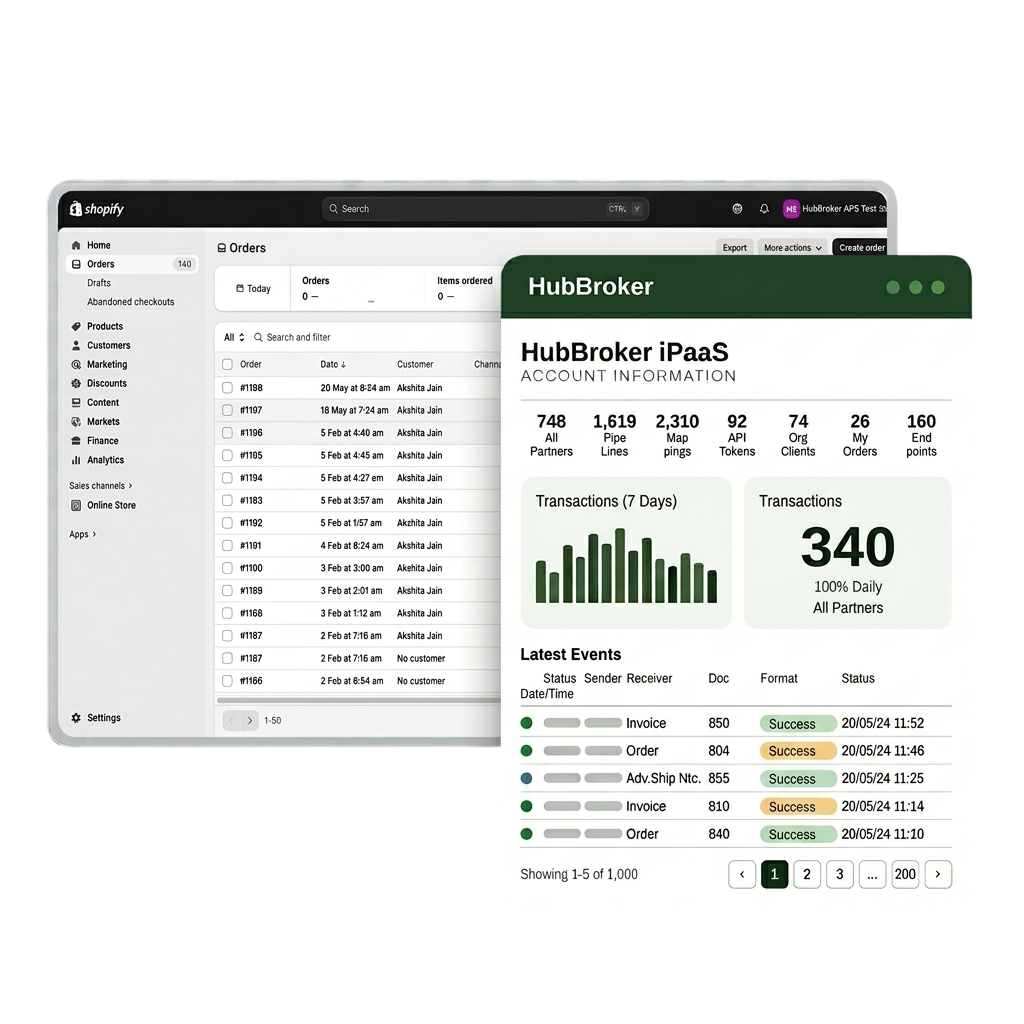















Connect Amazon with ERP systems through EDI to automate orders, inventory, shipping, returns, and invoice data exchange.
Connect BigCommerce with your ERP through EDI to automate orders, invoices, inventory, and shipping data exchange across systems.
Connect Visma e-conomic with ERP and business systems through EDI to automate invoices, orders, finance, and accounting data.
Connect Microsoft Business Central with ERP, commerce, and trading systems through EDI to automate orders, invoices, and inventory.
Connect Rackbeat with ERP and commerce systems through EDI to automate inventory, orders, purchases, and invoice data exchange.
Connect Microsoft Dynamics 365 F&O with business platforms through EDI to automate finance, supply chain, orders, and invoicing data.
Connect Shopify with your ERP through EDI to automate orders, inventory, invoices, and fulfilment data exchange across systems.
Connect Uniconta with business systems through EDI to automate invoices, orders, inventory, and finance data exchange.
Connect SAP Business One with trading platforms through EDI to automate orders, invoices, inventory, and finance data exchange.
Connect OpenCart with your ERP through EDI to automate orders, invoices, inventory, and shipping data flow across business systems.
Let's schedule a demo and discover how our integration platform connects your apps and automates processes.
15+
Years Experience
500+
Projects Delivered
2000+
Global Clients
40+
Countries
We review your Shopify stores, sales channels, fulfilment model, ERP, 3PLs, and the trading partners involved, so the EDI design fits how your eCommerce and back office operations actually run.
Your Shopify environment is prepared for EDI with API access, product and inventory feeds, order events, and store-level rules configured to support automatic sync with ERP and trading partners.
Shopify order, invoice, fulfilment, and inventory data is mapped to EDIFACT, X12, XML, JSON, and partner-specific layouts, so your store data flows into ERP and partner systems without breaks.
Retailers, marketplaces, 3PLs, and B2B buyers are added to your Shopify EDI flow with identifiers, document profiles, connection method, and any partner-specific rules for orders and shipments.
Shopify orders, returns, invoices, and inventory updates are converted between your store format and each partner or ERP format automatically, so your team does not build files by hand for each.
Test orders, fulfilment events, invoices, and inventory updates are exchanged end-to-end with each partner and validated against Shopify, ERP, and partner rules before the flow moves into production.
EDI flows are activated in your live Shopify environment with a controlled rollout across stores and channels, so customer orders, fulfilment, and invoicing activity continue without disruption.
Once live, Shopify order flow, partner activity, fulfilment status, and inventory sync are monitored, with support for new stores, channels, partners, and changes as your eCommerce business grows.













Shopify orders move into your ERP and out to 3PLs or warehouses automatically, so picking, packing, and shipping start sooner and customers receive tracking updates without manual intervention.
Stock levels stay aligned between Shopify, your ERP, warehouses, and other sales channels in near real time, so customers see correct availability and oversells become a much smaller daily issue.
Customer orders, returns, and updates flow into your ERP without rekeying, freeing your operations team from copy-paste work and giving finance a cleaner source for revenue and tax reporting.
For Shopify B2B sellers, invoices and purchase orders move to retail and wholesale partners in the formats they require, with validation built in so billing rework and disputes are reduced.
Run multiple Shopify stores, currencies, and regions through one connected setup, so adding a new market, store, or 3PL does not mean rebuilding your integrations from scratch each time.
Connect Shopify, Amazon, marketplaces, and your ERP through the same HubBroker platform, so your team manages a single integration layer instead of separate tools for every sales channel.
HubBroker solutions support businesses across industries where reliable data exchange, automation, compliance, and partner connectivity are essential.
Support fast-moving order, invoice, inventory, and marketplace workflows with automated document and system integrations.
Help manufacturers connect suppliers, customers, ERP systems, and logistics partners for smoother production and supply chain operations.
Enable structured data exchange for shipping, delivery, tracking, invoicing, and partner communication across logistics networks.
Support secure and accurate document exchange where compliance, reliability, and process efficiency are critical.
Help financial businesses improve document processing, data accuracy, reporting flows, and secure business communication.
Automate order-to-cash and procure-to-pay workflows across customers, suppliers, warehouses, and ERP systems.
Our Shopify integration is shaped around how online retail actually runs, covering orders, refunds, stock, fulfilment, and partner exchange instead of treating Shopify as just another data source.
Link Shopify to ERP, WMS, 3PLs, marketplaces, and trading partners through one platform, so your store is not isolated from finance, inventory, and supply chain teams during daily operations.
Shopify B2B sellers get certified Peppol Access Point connectivity built in, so invoicing public-sector and EU buyers can be handled inside the same automation setup, not a separate add-on.
Our Shopify EDI projects follow a clear path through requirement review, mapping, testing, and go-live, so eCommerce, IT, and operations teams share the same view of progress and timelines.
You work with teams in Denmark and India who understand Shopify, ERP integration, and EDI together, instead of being passed between separate vendors for each part of the technical setup.
Shopify can be extended with intelligent document processing, ERP API integration, and Peppol e-invoicing through the same HubBroker platform, so automation grows as the brand scales.

ERIKS is a globally recognized industrial service provider with over 80 years of experience in delivering technical products, engineering expertise, and tailored services.
Read More
Orkla House Care Europe, a division of Orkla ASA, is a leading manufacturer and distributor of high-quality painting tools for both professionals and DIY users. Operating across Sweden, Denmark, Norway, and the UK.
Read More
Ammega Group, through its Megadyne division, is a global leader in the manufacturing and distribution of power transmission belts and industrial conveyor solutions.
Read More
TDC Brands is a Danish telecommunications group, home to six brands: YouSee, TDC Erhverv, Telmore, Hiper, eesy and Relatel.
Read MoreHubBroker integration platform acts as a cloud-based middleware that connects different systems, enabling them to communicate and share data. We provides users with a unified, AI-powered platform with an intuitive user experience. Features include prebuilt connectors and integrations that empower non-technical users, and one-click access to powerful developer tools for technical users to help facilitate data integration and business process automation.
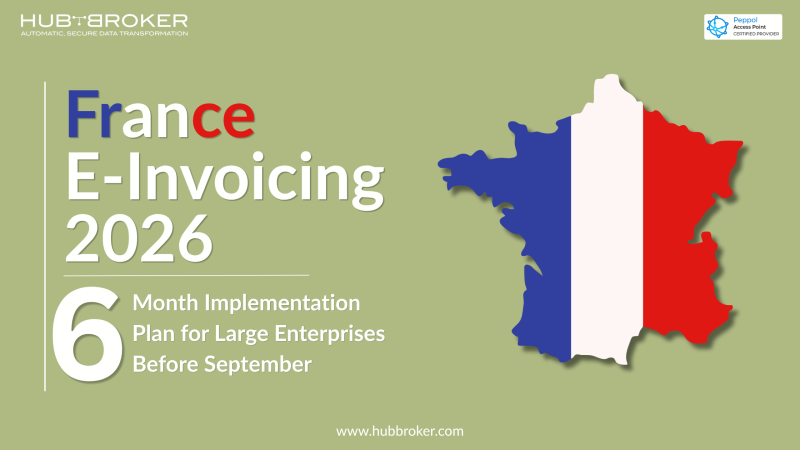
France’s e-invoicing reform is no longer a problem for next year. With the mandate going live on 1 September 2026, large and medium-sized businesses have under four months to onboard with an Approved Platform, connect their ERP, and start exchanging structured invoices.
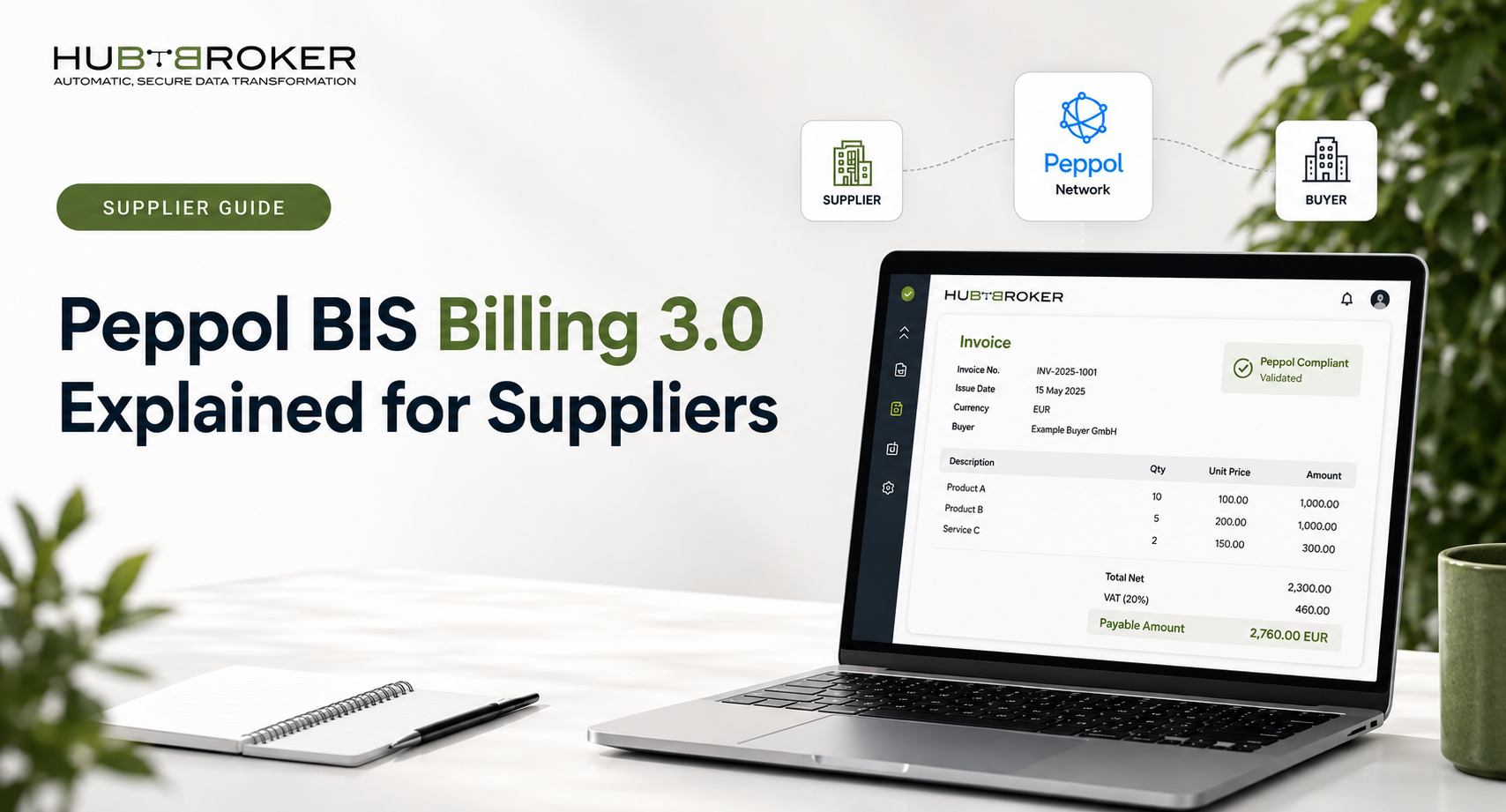
Quick Questions About Peppol BIS Billing 3.0 for Suppliers What is Peppol BIS Billing 3.0? Peppol BIS Billing 3.0 is the standard specification used to exchange electronic invoices and credit notes through the Peppol network.
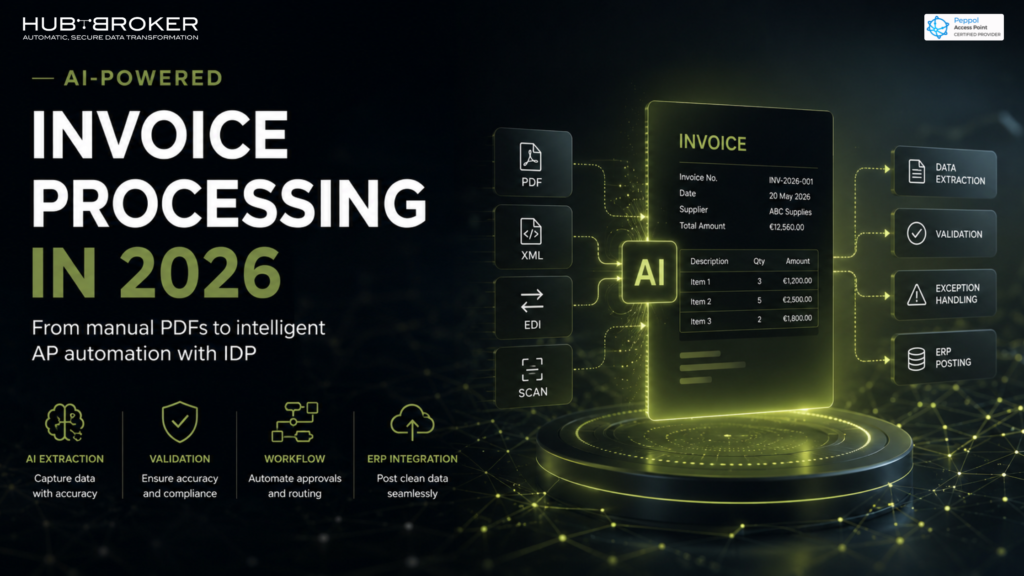
Invoice processing has quietly become one of the biggest bottlenecks in finance operations. For years, many businesses treated invoices as simple documents: receive a PDF, enter the details into the ERP, approve it, and pay it. But in 2026, that approach is becoming too slow, too risky, and too manual.
Bredgade 45B, København K, Capital Region , 1260, Denmark
D-1010, The First, B/H ITC Narmada, Ahmedabad, Gujarat, 380015, India